A Landscape Tour of the New Wallis Annenberg Wildlife Crossing
The Wallis Annenberg Wildlife Crossing will be more than just a walkway for animals—it will be a living bridge reconnecting long-separated wildlife habitats. Here’s what restoration experts planted.
Courtesy of Caltrans
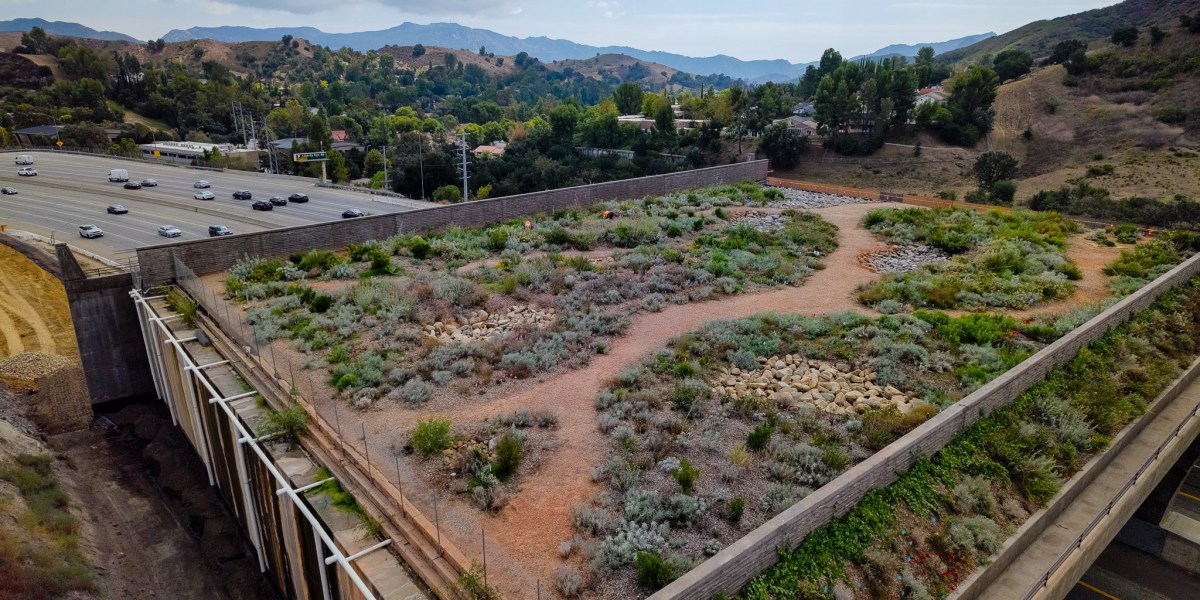
A landscape doesn’t appear overnight, especially when you’re trying to re-create one that has evolved over thousands of years. For the Wallis Annenberg Wildlife Crossing, the work began well before the first plants went into the ground. In 2022, a team headed into the surrounding hills to collect approximately one million seeds from native plants growing in the area. Those seeds would become the beginnings of a new landscape, one designed to help mountain lions, bobcats, coyotes, and other wildlife move safely across the 101 Freeway in Agoura Hills, CA.
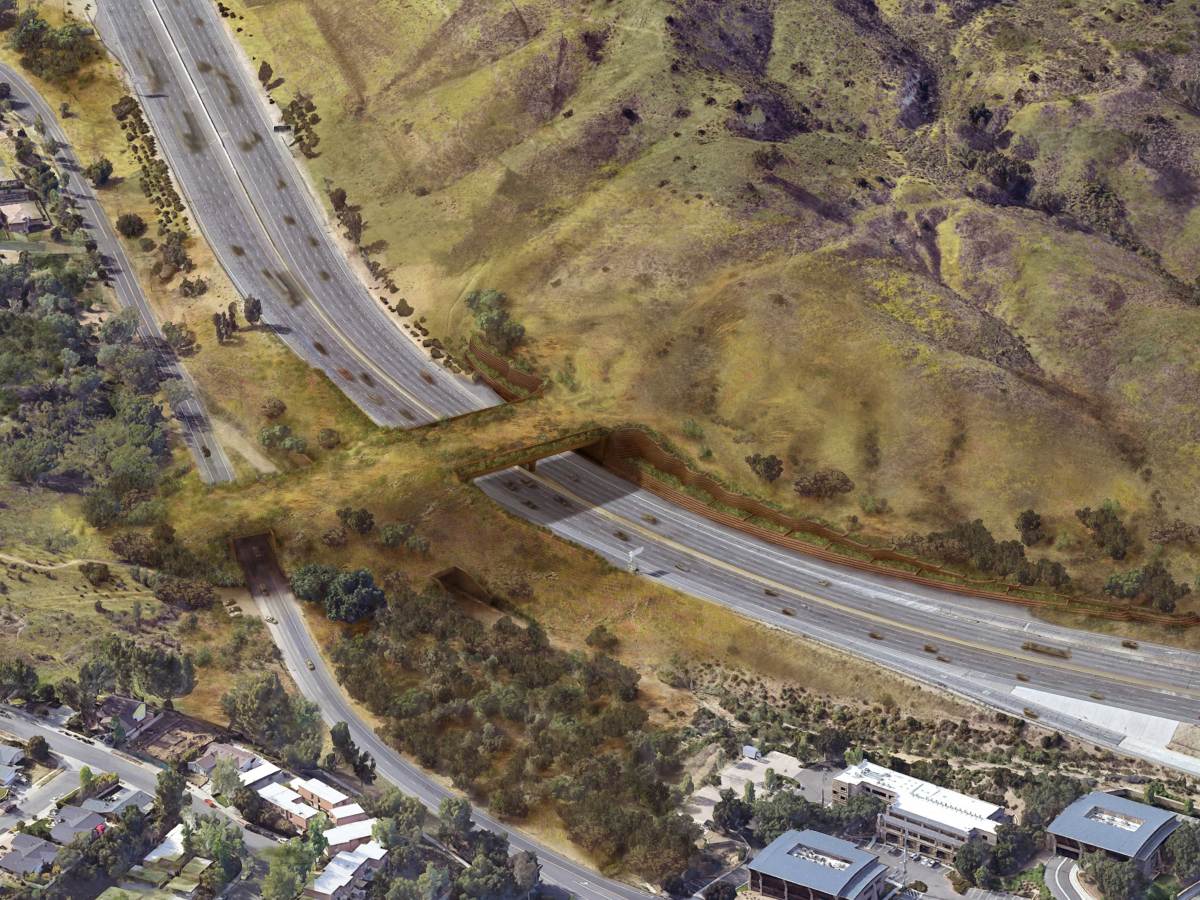
The 210-foot crossing, currently scheduled to open December 2, 2026, is part of a larger effort to reconnect habitat across the Santa Monica Mountains and Simi Hills. But its landscape is more than a finishing touch. Native plants, soil, and the living systems beneath them are essential to making the structure feel like a continuation of the surrounding habitat.
Rendering courtesy of Rock Design Associates and National Wildlife Federation
Robert Rock, president and CEO of Rock Design Associates and lead landscape architect overseeing the crossing’s design, has helped shape that vision. The growing work happens at a dedicated native plant nursery in Calabasas, where nursery co-managers Jewlya Samaniego and Jose Campos have spent years raising the plants that will bring the landscape to life.
From Surrounding Hills to the Nursery
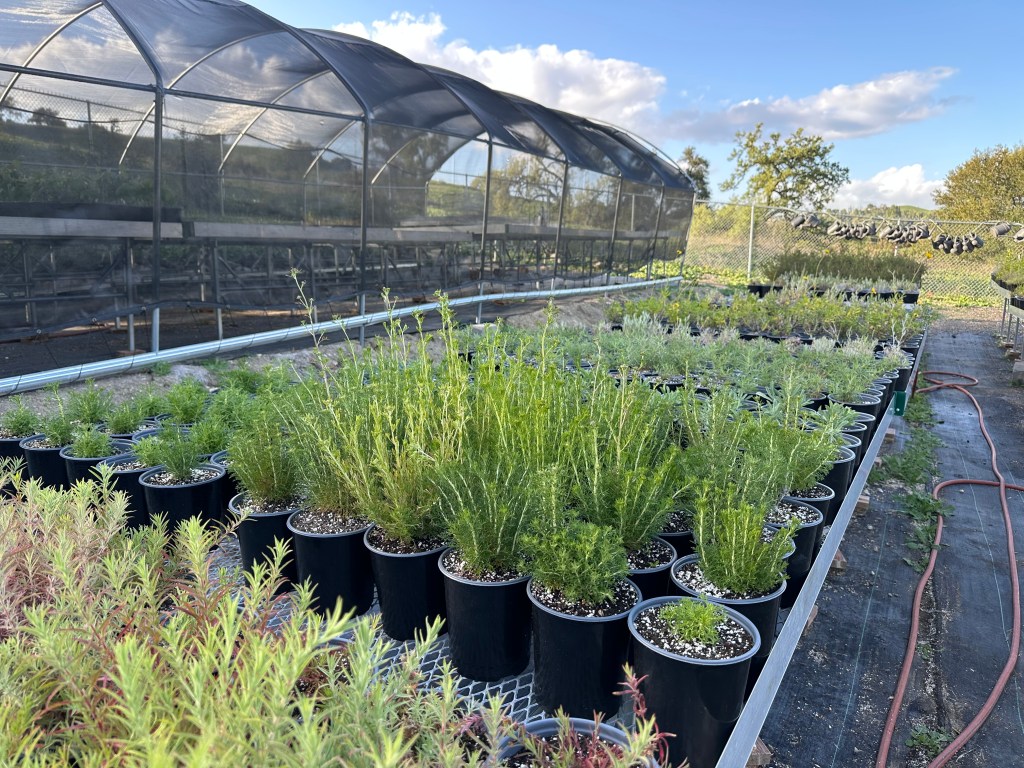
The nursery has one very specific purpose: growing hyperlocal native plants for the crossing. Established for the project on property managed by the Mountains Recreation and Conservation Authority, it is a collaboration among the National Wildlife Federation, MRCA, and the Santa Monica Mountains Conservancy.
The initial seed collection was led by the nursery’s first manager, Katherine Pakradouni. The collection area extended roughly five miles around the crossing, keeping the plants genetically connected to the landscape they would eventually help restore.
That local provenance is an important part of the project. The team is also thinking ahead to how the region’s climate may change, selecting seed from plants growing in hotter or more exposed locations. The hope is that those plants may carry characteristics that help future generations better handle similar conditions.
The nursery’s work is a long cycle of collecting, processing, propagating, and tending. For Phase II alone, more than 50,000 plants are needed, with approximately 20 percent additional stock grown to replace any that don’t establish. It’s a remarkable amount of growing for a very particular destination, and a reminder that restoring habitat takes considerably more than simply ordering plants and putting them in the ground.
Courtesy of Rock Design Associates
A Landscape Built from Plant Communities
The planting is happening in two phases, each with a different role in the larger restoration. Phase I focuses on the crossing itself, with more than 30 native plant species. Phase II extends into the surrounding habitat, incorporating more than 50 species.
The palettes include familiar Southern California natives: California buckwheat, black sage, toyon, laurel sumac, California fuchsia, and native grasses, along with coast live oak, valley oak, coffeeberry, chaparral yucca, and arroyo willow in the broader habitat restoration.
Rather than treating each plant as an individual specimen, the team studied how species grow in proximity to one another in natural settings. Rock explains, “we are trying to collect plants that are in the same general area that have that kind of relationship to one another.”
Those observations inform the planting plans, which organize species into mapped modules. The groupings give contractors a practical framework for installation while helping the design team monitor how plant communities change over time. The boundaries aren’t rigid; placements can shift in the field as the team responds to actual growing conditions.
And those conditions vary. South-facing areas receive intense sun, while other pockets hold moisture longer. The grading was adjusted to create small sub-watersheds where water can linger, and the north side incorporates restored hydrology along Liberty Canyon Creek. The result is a range of microhabitats, each with its own opportunities and challenges for the plants taking root.
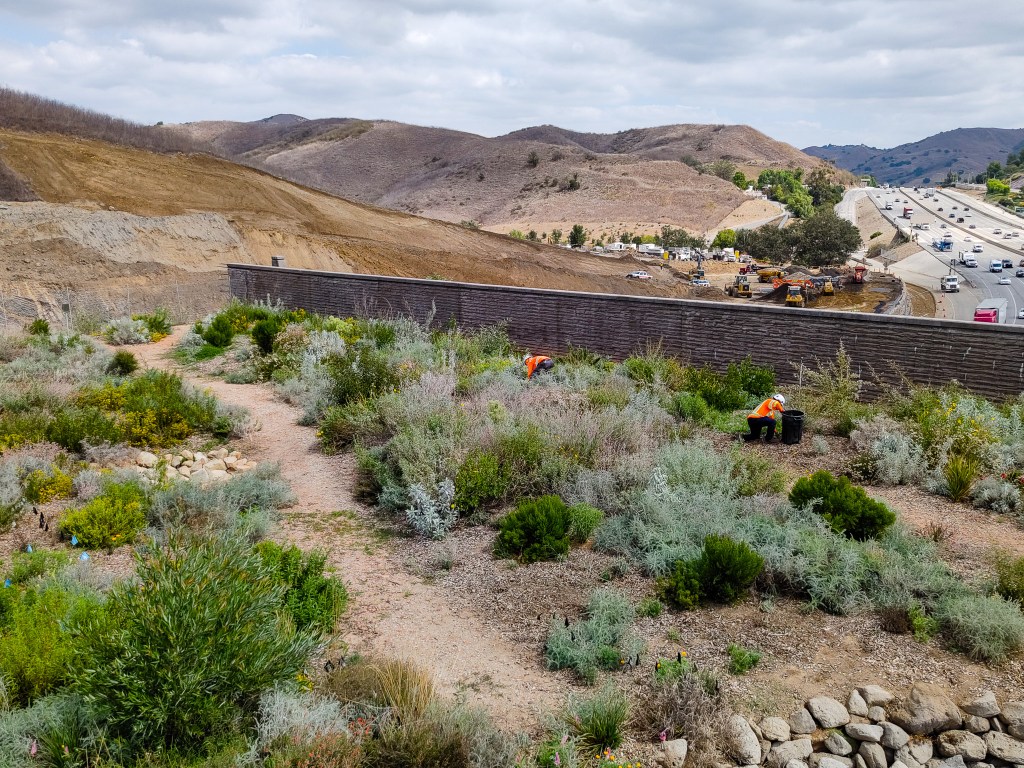
Courtesy of Caltrans
The Life Beneath the Plants
A native landscape depends on more than what grows aboveground. At the nursery, the team is propagating soil biology alongside the plants, including native fungi, bacteria, and other microorganisms.
Mycorrhizal fungi are particularly important. These fungi form mutually beneficial relationships with plant roots, helping plants access nutrients and water. The nursery has dedicated growing areas for different types, including fungi associated with oak trees.
The crossing’s soil was also inoculated with microbes and mycorrhizal fungi from the surrounding hills. A native cover crop, including Santa Barbara milk vetch, golden yarrow, California poppy, and giant wild rye, helps establish the soil biology and its natural nutrient cycle.
Rock describes the nursery’s approach as growing “both the plants and the soil ecology at the same time.” Rather than relying on conventional fertilizer, the project is working to reintroduce the living relationships that support a healthy native landscape.
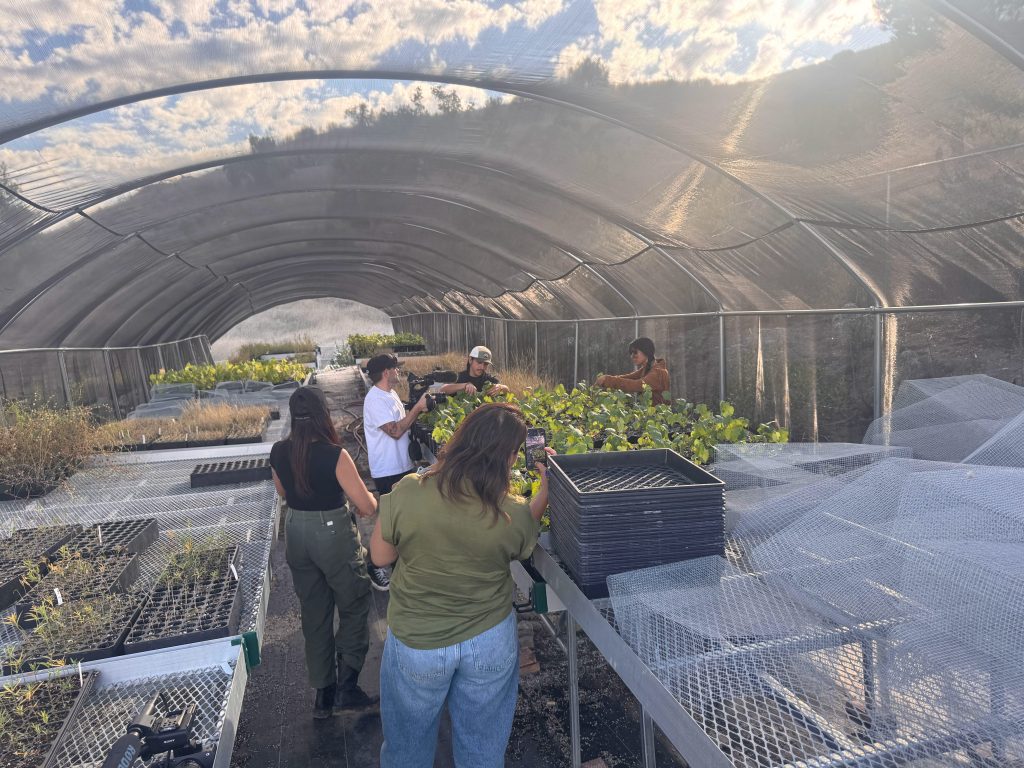
Courtesy of Rock Design Associates
A Native Grape Worth the Wait
One of the nursery team’s more memorable success stories is desert wild grape (Vitis girdiana). Finding and propagating the native vine took some persistence. Its preferred creekside habitats are increasingly difficult to find, in part because those areas are often developed. The team eventually located a source not too far from the crossing site.
Then came the learning curve. The birds love the grape’s small fruit, so the team had to figure out the right time to collect it. The plant also goes dormant, adding another consideration to the propagation process. They experimented with cuttings, too, although most of the nursery’s propagation work relied on seed. “We tried cuttings, and that was also a challenge,” the team shared. Eventually, they got the process dialed in and were able to grow enough for the project.
The vines were planted while dormant, when they looked like little more than twigs. Today, they’re among the plants doing particularly well on the crossing, growing against an exterior wall where reflective heat presented an additional challenge.
That placement was a calculated gamble from the design perspective. As Rock explained, the team needed a vine, wanted to use something native, and desert wild grape was the only native grape available. After roughly six dozen propagation crops, the team had figured out how to grow it successfully.
It’s a small but satisfying example of the patience behind the larger project: finding the right plant, learning what it needs, and giving it the time and attention to thrive. You can spot the wild grape growing (and thriving) on the outside of the bridge along the exterior wall.
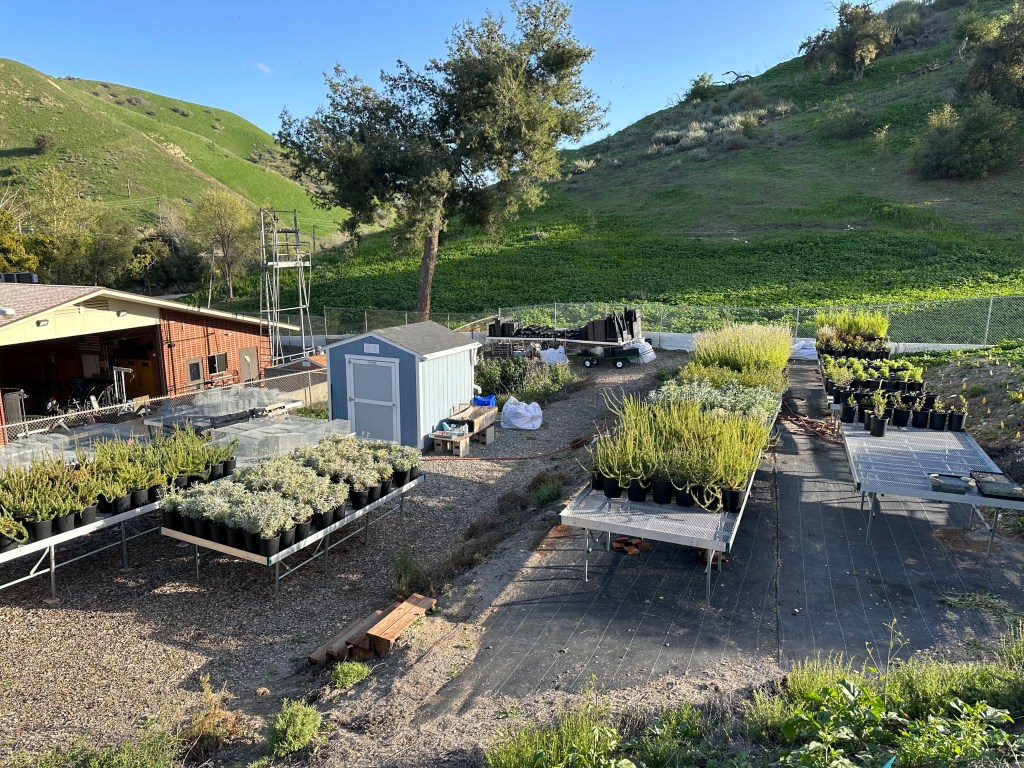
Courtesy of Rock Design Associates
A Landscape Still Finding Its Footing
When the crossing opens, the planting won’t be a finished landscape so much as the beginning of a long-term restoration effort. Oaks will take years to mature. Smaller plants will establish, compete, and shift as the landscape responds to its different conditions. The team will continue monitoring how those plant communities develop over time while helping rebuild a connection between habitats that wildlife has needed for generations.
For home gardeners, there’s a useful reminder in that approach. Start with plants suited to local conditions, pay attention to how they grow together, and consider the soil and water as part of the garden rather than separate considerations. A native garden isn’t simply a collection of plants from the region. It’s a living community that takes time to find its footing.