
The ‘Mailbox Garden’ Is the Quickest Way to Add Curb Appeal
A small strip of land can do a lot. Here’s how to fill it with beauty, habitat, and year-round structure.
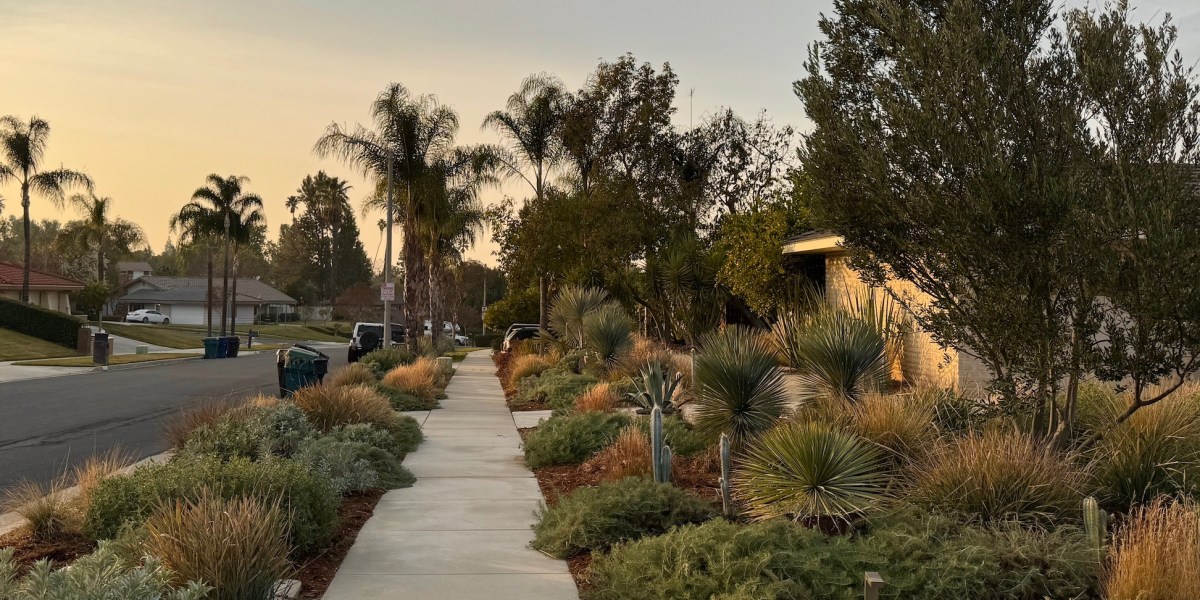
Courtesy of Ferox Studio
The strip of lawn between the sidewalk and street is one of the hardest-working, least-loved patches of a garden. It gets baked by the sun, compacted by foot traffic, and occasionally commandeered by a delivery driver. But what if that little sliver of land were a garden?
Enter the “Mailbox Garden,” a miniature landscape that turns an everyday arrival into an opportunity for curb appeal, habitat, and a little more beauty for everyone passing by. Fall is an especially good time to rethink the space, whether that means swapping thirsty turf for drought-tough plants, adding California natives, or layering grasses, shrubs, and seasonal color around the mailbox.
The trick is to treat the strip as more than leftover real estate. The best designs feel connected to the garden beyond the sidewalk while accounting for the very public, very practical nature of the space. I asked three Western landscape designers to share their formulas for creating a mailbox garden that looks intentional, works hard, and gives something back to the neighborhood.

Courtesy of Morami Studio
Morami Studio, Ojai, CA
POV: Treat the parking strip as an extension of the garden. Morgan Ramirez of Morami Studio uses the space to echo the landscape beyond while adding privacy, shade, and habitat.
Build the Palette
- Carry the garden through. Ramirez likes to repeat the primary garden’s plant and hardscape palette, with tougher alternatives for the more public-facing strip.
- Think beyond flowers. A 4- to 5-foot strip can accommodate trees and shrubs that provide screening, shade, and habitat. Ramirez has used Heteromeles arbutifolia (toyon), lemon trees, Malosma laurina (California sumac), and Ceanothus species.
Layer for Impact
- Start tall. Ramirez begins with trees and screening shrubs, considering their mature size before filling in the lower layers.
- Keep the understory low. Favorites for higher-traffic areas include low-growing Ceanothus, Muhlenbergia rigens (deer grass), Salvia leucophylla (purple sage), and Calystegia macrostegia ‘Anacapa Pink’ (Anacapa Island morning glory).

Courtesy of Morami Studio
Design for the Real World
- Remember who shares the space. “It’s important to know this is a public space, and you are acting as a steward of that space.”
- Solve irrigation first. If hand-watering is the plan, simplify the planting and consider boulders, gravel, or brick as part of the design.
Add the Finishing Touch
- Make it feel connected. “When the strip looks like an extension of the primary garden, you will feel and people will know it is intentional.”
- Give something back. Ramirez sees the planting as “a little splice of your garden you are giving back to the public realm; that’s a beautiful, gracious thing—don’t neglect that opportunity.”

Courtesy of Friday Gardens
Friday Gardens, San Francisco, CA
POV: Go tough, textural, and restrained. Dani Coulter of Friday Gardens creates hardworking plantings with repetition and strategic layering.
Build the Palette
- Choose tough stuff. Coulter favors plants that can withstand or deter foot traffic while providing texture, color, and habitat.
- Mix evergreen structure with seasonal bloom. Her picks include winter-blooming Aloe striata, evergreen Lomandra, Westringia for purple blooms, and Dymondia as a walkable groundcover. Anchor the planting with a small Acacia or a plant from the Protea family.
Layer for Impact
- Limit the palette. Three to five species, repeated in clusters or swaths, keeps a compact garden cohesive.
- Contrast textures and heights. Pair fine-leaved Grevillea or Lomandra with substantial foliage such as Kalanchoe beharensis or agave. Use one tall species, one or two mid-height plants, and a groundcover, with wispy grasses for movement.

Courtesy of Friday Gardens
Design for the Real World
- Map movement first. Use walkable groundcover or gravel where people need access, and let spiky agave or cactus signal where they should not walk.
- Go low-water. Drought-tolerant California natives and Mediterranean plants are better suited to spaces where daily irrigation isn’t practical.
Add the Finishing Touch
- Think high, medium, low. Coulter’s formula is a large specimen, a lush mid-height bloomer, and a groundcover or tuft of grass spilling toward the sidewalk.
- Repeat for fullness. Repeating those layers in swaths makes the garden feel abundant without becoming busy.
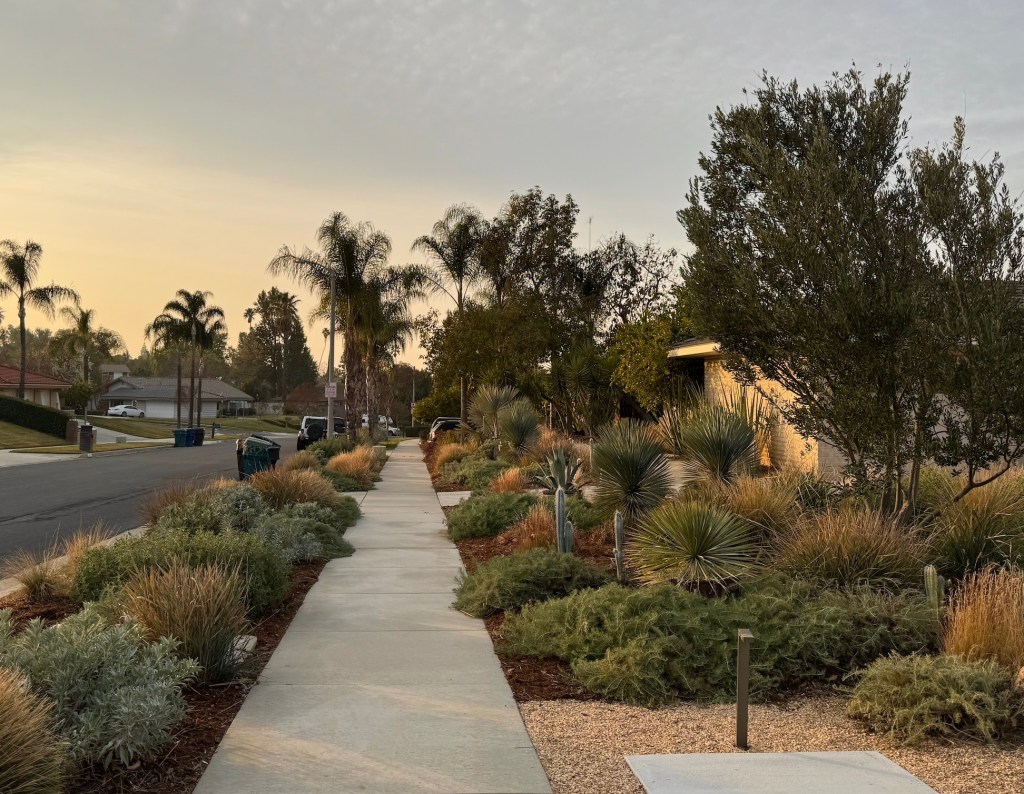
Courtesy of Ferox Studio
Ferox Studio, Los Angeles, CA
POV: Think of the parking strip as the garden’s trailer, not its leftover space. Aimee Kirby of Ferox Studio uses it to preview the materials, textures, and planting language of the landscape beyond.
Build the Palette
- Create cohesion. “Does it create cohesion with the rest of the landscape? Can you repeat materials, plants, or textures found elsewhere in the garden?”
- Balance soft and sculptural. Kirby pairs Muhlenbergia dubia and Aristida purpurea with agave ‘Blue Glow’ and Mexican fencepost cactus, adding native sages, gaura, and St. Catherine’s lace for texture and pollinator habitat.
- Use rocks for structure. Boulders add sculpture and year-round interest without adding to the irrigation load.

Courtesy of Ferox Studio
Layer for Impact
- Blur the edges. Soft, lower-growing plants can transition the garden into sidewalks and driveways, while taller architectural plants draw the eye inward.
- Add verticality without bulk. Cacti bring height and structure without taking up much horizontal space.
- Make room for color. “You can create an entire color story in even the smallest square footage, whether it’s a silvery sage palette, something soft and white, or an explosion of color. There are no size boundaries on color. Go wild!”
Design for the Real World
- Expect some abuse. “You should expect a tiny garden like this to take some abuse, whether from foot traffic, parked cars, drainage, or pets, so it’s important to design with that reality in mind.”
- Direct traffic. Plant densely to discourage pets, and use flagstones or pavers to clearly mark where people should walk. Keep paths, sightlines, and the mailbox address clear.
Add the Finishing Touch
- Repeat materials. Stone, paving, color, or texture used elsewhere on the property helps connect the strip to the larger landscape.
- Give a preview. Kirby calls it “a little garden movie trailer,” offering a glimpse of the design ethos waiting beyond the front door.