
The Tahoe Effect: What Happens When We Let Ourselves Feel Awe
A new three-part documentary follows UC Irvine researchers into the field on Lake Tahoe’s South Shore—and finds a mindful visit to a magnificent place can shift how we feel about ourselves, one another, and the natural world.
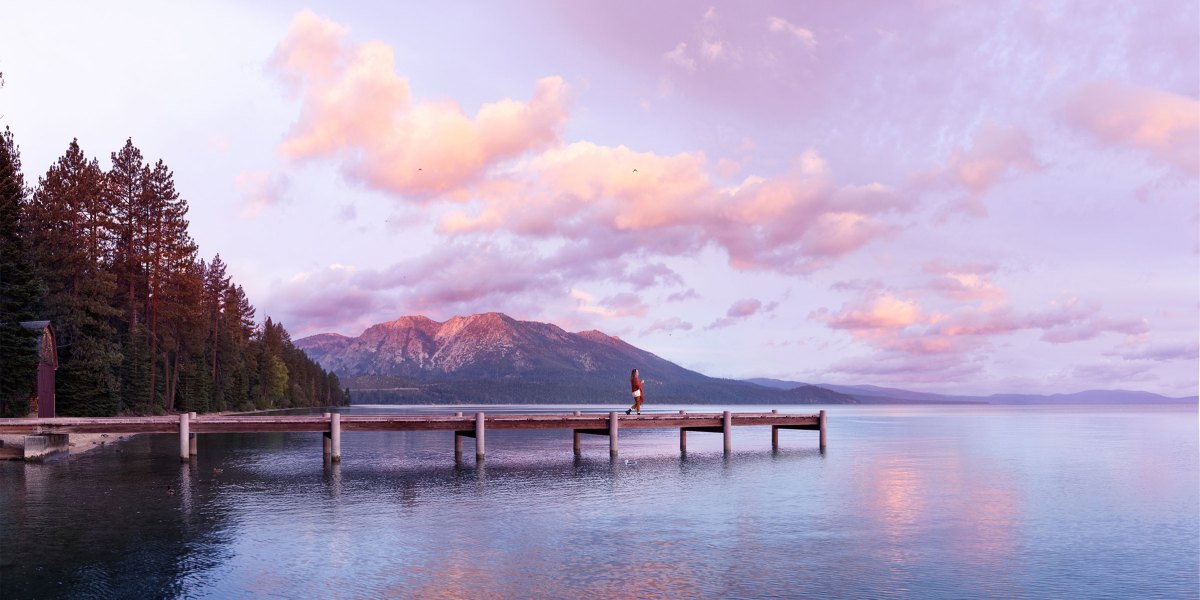
Courtesy of Visit Lake Tahoe
Astronauts have a name for the shift that can happen when they see Earth suspended in the dark: the overview effect. From above, borders disappear, the atmosphere looks impossibly thin, and our preoccupations yield to a larger truth—we share one beautiful, fragile home. You do not need to leave the planet to feel a version of that perspective. Sometimes you need only to stand before something vast enough to interrupt your usual scale of things. On the South Shore of Lake Tahoe, the blue water, granite, forest, and sheer reach of the sky can do exactly that.
At Sunset, our internal brand mission is to “unlock the infinite awe of the West.” That is more than a poetic way to describe beautiful places. We have long believed that wonder is good for us—and that it can make us better to one another and more protective of the landscapes that inspire it. We also love Tahoe, a place that has delivered that jolt of perspective to generations of Westerners. So we were excited to see Beyond Awestruck: The Scientific Search for Connection, a new three-part documentary that asks whether Tahoe’s effect can be measured. The answer, according to preliminary findings from an ambitious field-research project, is yes. Seen that way, the documentary is also a compelling model for responsible tourism: deepen your understanding of a place, experience it more sensitively, and let that deeper experience shape how you care for it.
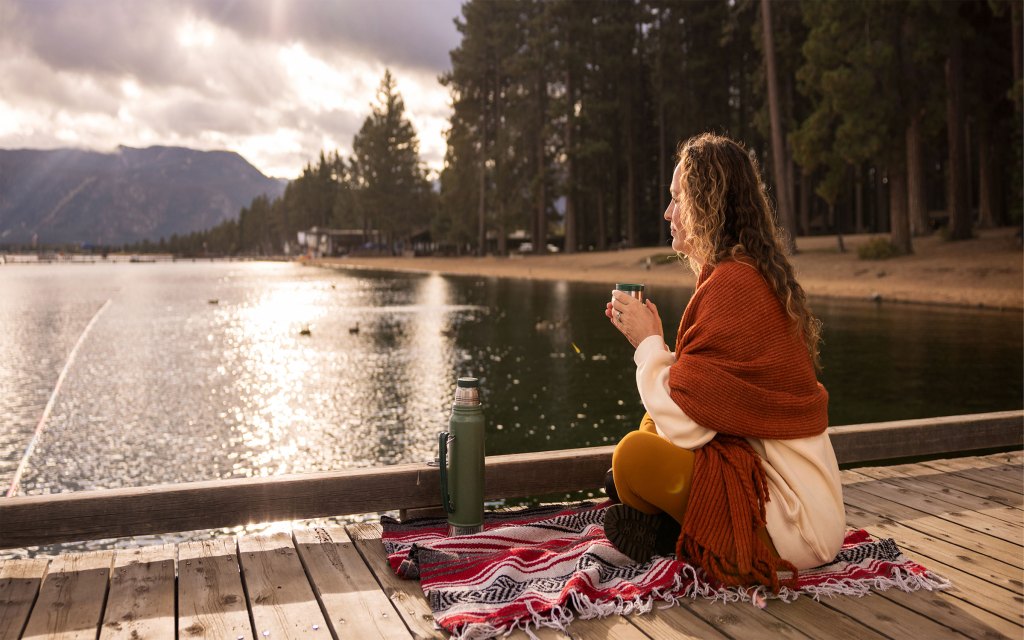
Courtesy of Visit Lake Tahoe
Awe, Measured in the Wild
The series follows social psychologist Dr. Paul Piff and a University of California, Irvine, research team as they turn Tahoe into an open-air laboratory. In summer 2025, the team conducted seven studies with more than 1,000 participants at overlooks, trails, the Heavenly Gondola viewpoint, and on the lake. Some experiments compared people invited to engage mindfully with the landscape against control groups; others surveyed participants before and after an experience. The results are being developed into peer-reviewed papers, but the early effects are unusually large for psychological research outside a controlled lab.
Awe has a more precise meaning here than “that’s awesome.” Piff describes it as the emotion we feel before something so vast, powerful, or complex that it exceeds our understanding. Psychologists call the mental adjustment that follows a “need for accommodation:” The world has presented something our existing frame cannot contain, and the mind must expand to take it in. Time can seem to slow. Our sense of self can diminish. Paradoxically, feeling smaller can leave us less isolated, because we locate ourselves inside something larger.
The Tahoe research revealed an important distinction: Proximity to nature is not the same as presence in nature. In an early study on the Van Sickle Trail, hikers received no prompt to pay attention, and awe did not measurably rise. Anyone who has marched up a trail while replaying emails, watching their feet, or chasing a fitness goal will recognize the problem: A spectacular landscape can become background. In later experiments, researchers offered three simple instructions without telling participants to feel awe: breathe, sense, savor. Slow the breath. Open the senses. Stay with what is good instead of hurrying past it. That small act of attention changed what people took from the view.
What Two Minutes Can Do
At one scenic overlook, participants were randomly assigned to spend two minutes appreciating the view or the same time on their phones. Compared with the phone group, those attending to the landscape reported 70 percent more awe, 37 percent more contentment, and 33 percent more happiness. At the Heavenly Gondola viewpoint, two minutes with the panorama—compared with browsing the gift shop—produced an 8-percent increase in life satisfaction and a 12-percent greater connection to the world. Participants also anticipated 13-percent greater success in an important but difficult conversation. Statistical modeling suggested that awe, not simply a better mood, drove that openness.
The documentary gives those numbers faces. Couples arrive carrying unresolved conversations; with the lake and mountains around them, the walls and worries of daily life begin to fall away. One participant recognizes that what she is going through is only one part of a larger reality. Another sums up the shift simply: It is all perspective. The setting does not erase conflict. It changes the scale around it—and can make room for listening, gratitude, and a sense that the relationship is bigger than the immediate problem.
Other moments widen connection across generations. Donner Party descendants encounter the landscape as a living link to ancestors whose experience there shaped their family history. On the water, Piff watches his young son peer through a clear kayak into Tahoe’s blue depths. The boy’s eyes widen; language gives way to an astonished stream of “whoa.” For Piff, seeing Tahoe make this kind of impresion on his child forges a new bond between parent, child, and place: first the involuntary surprise, then the meaning we make from it.
The series also makes clear that Tahoe is not an empty stage awaiting a visitor’s discovery. BillyHawk Enos, a member of the Washoe Tribe, speaks of the lake as sacred and water as a gift that cleanses and sustains life. His perspective carries a relationship to this place measured not in vacations but in generations. The lesson is more demanding than “take in the view.” Awe means engaging with a place, humbling yourself before it, and recognizing obligations beyond your own experience.
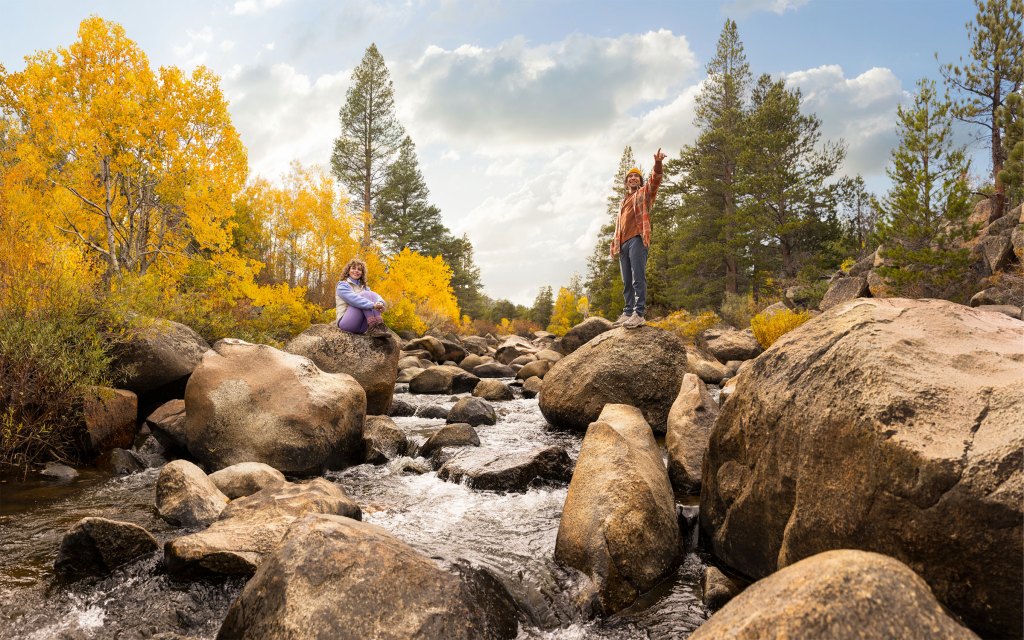
Courtesy of Visit Lake Tahoe
From Wonder to Responsibility
That outward turn is consistent with Piff’s earlier research. In one experiment, students spent 60 seconds looking up at tall eucalyptus trees while a control group faced a building. Afterward, a researcher staged a small accident and dropped pens. Those who had looked at the trees were more likely to stop and help. Across five studies, Piff and his colleagues found awe associated with greater generosity, ethical decision-making, and prosocial behavior, in part because it reduced the importance of the individual self. The Tahoe project asks how those ripples move through a real destination: into relationships, well-being, and care for nature.
Early Tahoe findings suggest the ripple reaches the landscape itself. Participants reported a 20-percent increase in environmental stewardship after awe experiences; water-based activities were associated with a 7-percent decrease in anxiety, and an awe-enhanced hike with feeling 9 percent calmer and more energized. The figures support what thoughtful travelers have long sensed: A place can restore us, but the best version of that exchange is reciprocal. We leave more willing to protect what gave us that feeling.
On Tahoe’s South Shore, reciprocity has practical form. Visit Lake Tahoe’s Rules to Lake By ask travelers to protect the awe, leave less, park with heart, practice kindness, and move on “Tahoe Time”—savoring rather than sprinting. Mindful travel is not passive scenery consumption. It means putting down the phone, respecting closures and parking rules, packing out what you bring, making space for others, and remembering that the lake, trails, wildlife, and communities are not props in a personal highlight reel.
One of the simplest ways to put that thinking into practice is to reconsider when you visit. October brings cooler hiking and biking weather, golden aspens, and a quieter, more reflective lake. Return in spring and the experience changes again: Snowmelt sends waterfalls rushing, the first buds and wildflowers appear, and the landscape seems to awaken in real time. Conditions in the mountains always require some flexibility, but visiting during these bridge seasons can mean more space to slow down and pay attention while spreading the benefits—and the impacts—of tourism beyond the busiest summer and winter periods. It is a triple win: a richer experience for the traveler, more support for the community across the year, and a lighter way to encounter the place itself.
This is the most hopeful idea in Beyond Awestruck: Awe is available, and it is a practice. Tahoe’s South Shore may be one of the West’s most powerful places to remember how because its scale, clarity, and living history make distraction difficult. The practice begins with attention: breathe, sense, savor. Watch the three-part documentary, then plan time on the South Shore not simply to see more, but to be fully present with what you see. If two minutes can enlarge happiness, belonging, and responsibility, imagine what a thoughtfully spent trip might set in motion.
Keep Reading:
The Latest