These Are the Airplane Stretches a Yoga Instructor Does to Stay Centered and Relaxed While Flying
Keep your body aligned with these simple in-flight movements.
petrenkod/Getty Images
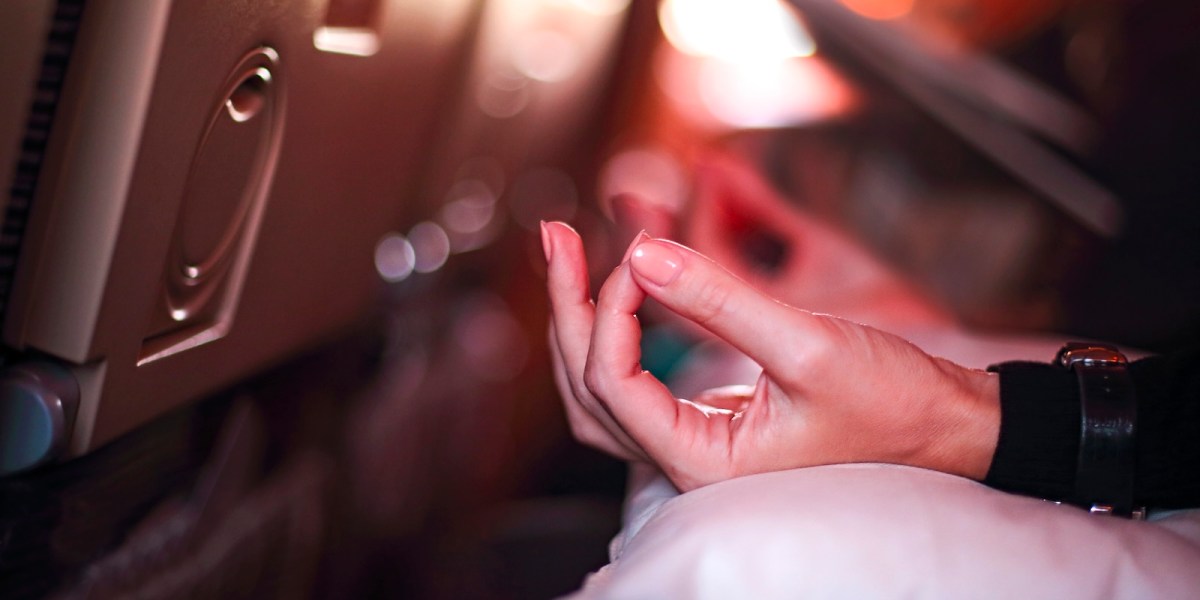
Person in airplane with aerophobia scared of flying being afraid while sitting in airplane seat and doing yoga for relax
Between the stress of getting to (and through) the airport, jet lag, and being stuffed into an uncomfortable seat for hours on end, flying can be an incredibly dysregulating experience. And while I’m totally guilty of heading to the galley for some stretches mid-flight, there are ways to get your alignment in order without disrupting the flight crew.
Catrina Reeder, the director of new studio openings at CorePower Yoga, has been teaching for more than a decade and her tips on in-flight postures prove that even though you’re smooshed onto a tin can hurtling through the air, you can still find your center. Here are her six favorite stretches for flying, and how to perform them in sequence (without completely ticking off your neighbor).
Seated Breath
This posture helps with slowing down the heart rate and activating the parasympathetic nervous system (our rest and digest state). It also brings awareness to how shallow our breath can be, making for less available oxygen to the body.
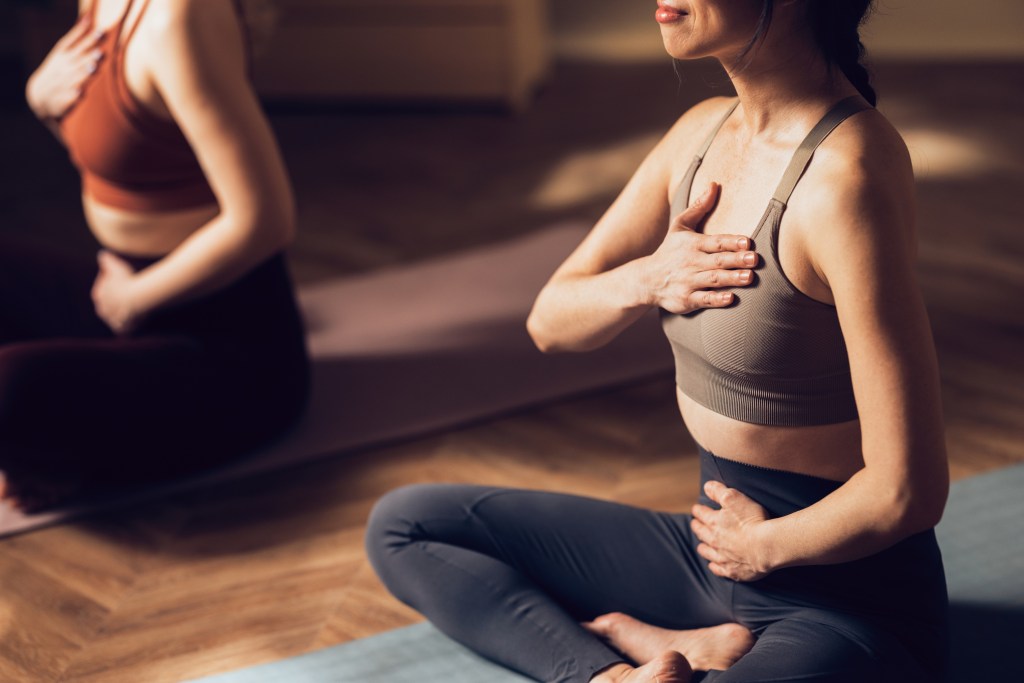
How to do it: Take a seat and place one hand on your heart and one hand on your belly. Soften your face, jaw, and temples, and when you’re ready, close your eyes. Feel how the seat is supporting you. If your feet touch the floor, use the floor to add even more support. Breathe in and see your entire ribcage expand its full 360-degree cylindrical shape—the sides, front, and back. Breathe out, and soften your shoulders. Breathe in deeply and feel your belly expand into your palm. Breathe out, and feel your chest relax into your palm. Take three to five breaths just like this.
FreshSplash/Getty Images
Seated Cat-Cow
This posture brings great mobility to the spine, especially in spinal extension, which helps to counter any rounding and promotes better posture.
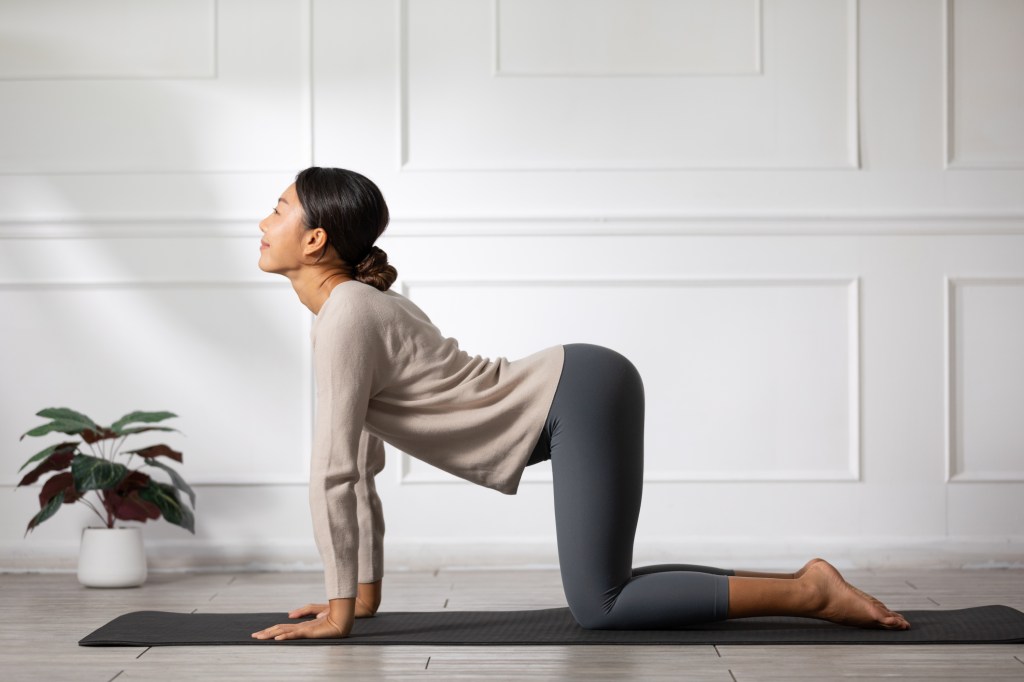
How to do it: Start seated with your feet touching or reaching toward the floor. Take a breath in and lengthen your spine away from your seat. Place your palms on your lap or grip the edges of your seat. Inhale for seated cow. Look up and press your chest and torso forward to arch your back. Exhale for seated cat. Tuck your chin, look toward your belly button, and round your back. Do this for five to eight repetitions. Try your best to match your inhale and exhale with your movements, and move mindfully.
Jomkwan/Getty Images
Seated Side Stretch
The seated side stretch targets length in the torso, similar to cat-cow, with the addition of inviting a gentle core activation on one side, and stretching on the other.
How to do it: Inhale for a seated mountain pose. Reach both of your arms up, as you relax your hips down into your seat. If there is any discomfort around the shoulders or neck, widen your arms or find a bend in your elbows. You can also reach straight forward or out to the sides instead.
On your next exhale, do a seated side stretch to the right. Reach your right arm down toward the ground and your top arm, elbow, or shoulder to the right side. You can reach toward the side of your seat or the side of your shoes or feet, if accessible. If your neck and shoulders feel OK, look up over your opposite shoulder, and add on by reaching your left arm up.
Return to center and repeat five to eight times, aligning breath and movement. Inhale center, exhale reach right, inhale center, exhale reach left. Continue to relax your hips into your seat and hug the muscles in your core. It’s normal for our range of motion to be different from one side to the other, so do your best to move in a balanced way.
Seated Twist
This pose helps us to finish out all of the movements of the spine (cat-cow, side stretch, and now twist). Just like the others, this pose promotes better posture and spinal mobility, and gets us moving in a completely different way than we might throughout the day. While twisting, make sure you are doing so like a spiral staircase. Start from the bottom, then the middle and the shoulders, neck, and even your eyes.
How to do it: Come back to center. Plant your left palm on your lap. Inhale and reach your right arm up, look up toward your thumb, if accessible. Exhale and draw a wide circle to the right with your palm, and follow your palm with your gaze. Land your palm toward or on the back of your seat. Keep your spine tall and take slow breaths. You might find that you can most comfortably reach the side of your seat; stay there until you feel ready to reach the back of your seat.
Imagine you’re picking a ripe orange from a tall tree as you inhale, reach a little taller, exhale, and plant your orange in a “basket” behind your seat. Continue to breathe into the twist as you direct your focal point to eye level or slightly higher. Flow through a few more of these on the right side, then switch to the left. Pick a whole basket of oranges if you’d like! A teacher taught me this visualization and it was so helpful to make the movement more intentional!
Seated Hip Stretch
What we call our “hips” are actual several muscle groups including our glutes, hip flexors, and adductors. In short, lots of muscles that help us to move and stand upright. Stretching them helps to bring blood flow and mobility, and delivers better support to critical parts of the body: our pelvis, spine, and legs.
How to do it (Option 1): Move your legs so you are making an “L,” and plant your left foot forward so your knee is facing forward and place your right foot off to the side so your knee and toes are facing to the right. See the “L” your legs are making? Prop your elbow on your right knee (the one facing to the side) and look toward the ceiling. If you want more, take your elbow inside of your leg or reach your hand toward your ankle. Stay for three to five breaths. Come back up to a seated position.
Switch to the other side so that your left leg is facing the side and your right knee is facing forward. Put your left elbow on your leg and look up to the ceiling. Reach toward your left ankle for more.
How to do it (Option 2): Start from seated with your feet on the ground. Hug your right knee into your chest and cross your ankle on your thigh. Place your palms on your lap or do a gentle squeeze on either side of your leg. Stay there and breathe for three to five breaths. For more, lean forward to rest your chest toward your lifted leg. Come back up to a seated position and switch legs.
fizkes/Getty Images
Seated Forward Fold
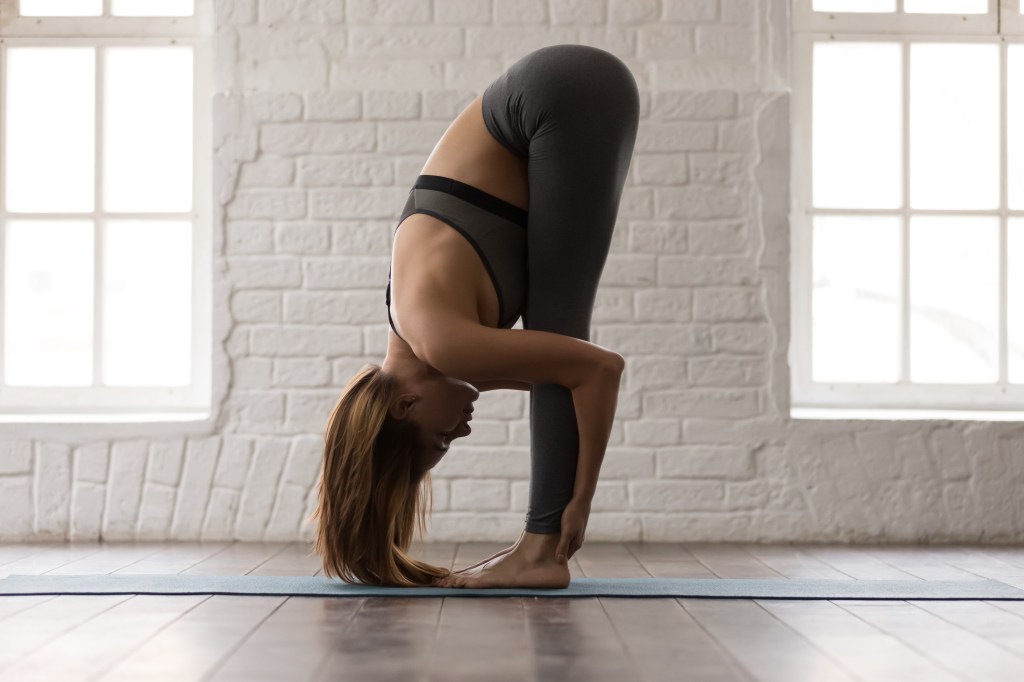
Forward folds are great for countering all of the sitting and compression we experience from day to day. In a way, they serve as an inversion, because our head is below our heart, which can be a great energizer (just be mindful as you sit up or avoid this altogether if you experience vertigo or migraines).
How to do it: This is an excellent pose to help you feel calm, and a great way to end this sequence. Start in a seat, then tuck your chin into your chest and round your spine as you reach down toward the ground. Pretend like you’re about to tie your shoes or pick something up off the ground. I prefer to do this with my legs wide so my torso can rest in between my legs. You can also do this with a pillow as a rest between your belly and thigh. Let your arms, neck, and shoulders dangle and decompress. Stay for three to five breaths or more if breathing is comfortable. On your way up, go slowly, and climb up your leg for support. Keep your head tucked as you rise up.