This Five-Day Hawaiian Surf Retreat Can Change Your Life
Longboarder Kai Sallas blends ocean adventure with a lesson in patience, courage, and finding flow, on and off the board.
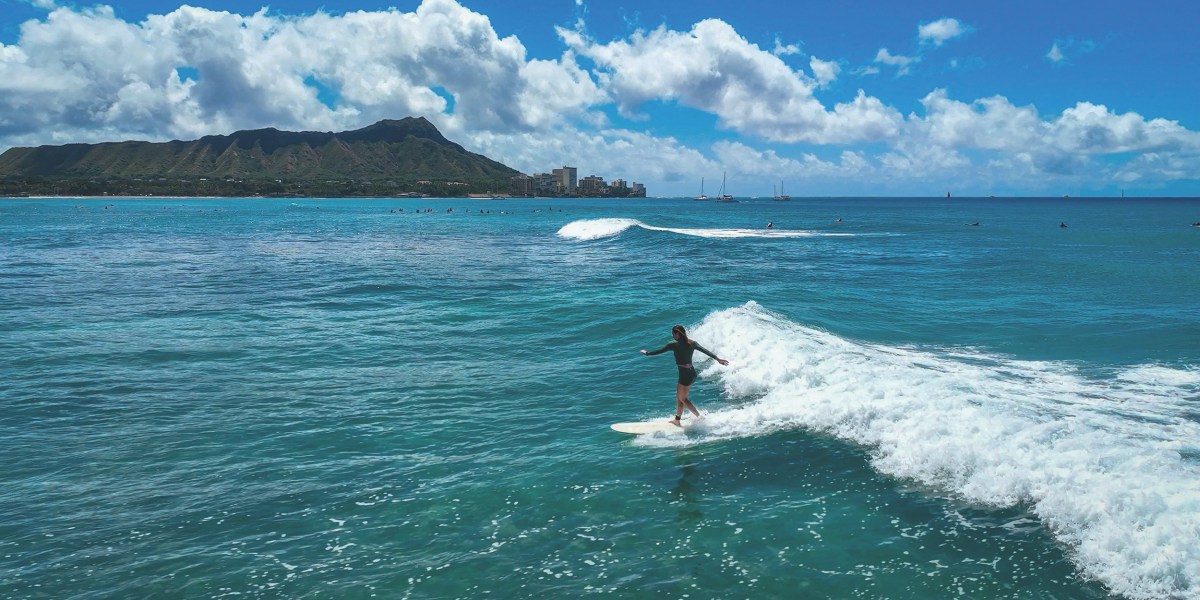
Author and travel editor Krista Simmons finds her footing cross-stepping on a wave on Waikiki. Photo by Matty Leong.
Author and travel editor Krista Simmons finds her footing cross-stepping on a wave on Waikiki.
Pulling up to the Kaimana Beach Hotel, I came down with a case of the jitters. Far from the usual wave of calm I’ve felt when touching ground on Oahu, the nerves hit as if it were the night before summer camp. The next morning, I would be embarking on my first surf retreat with Hawaiian longboarding champion Kai Sallas. And my inner critic started to nag as I unpacked my surfsuits (and my ego). What if I’m the worst of the bunch? Am I too old to be doing this? What if this isn’t for me? But I committed to carving out the time as a gift to myself for my 40th birthday. And there was no turning back now.
Sipping a mai tai at the hotel bar, I listened to a local guitarist playing Hawaiian slack-key tunes. The sun set, my tensions eased, and I headed upstairs to the conference room overlooking the ocean to meet the group. This would be one of our two classrooms for the week—the other being the crystal-clear waters of Waikiki’s Gold Coast right outside. I introduced myself to the other campers, a mixed bag of locals and travelers whose ages spanned from 30-something all the way up to surfers in their 70s. Sallas spent time hearing out our goals and asking what we were riding back home so he could kit us out with a board from his colorful quiver for the week.
Matty Leong
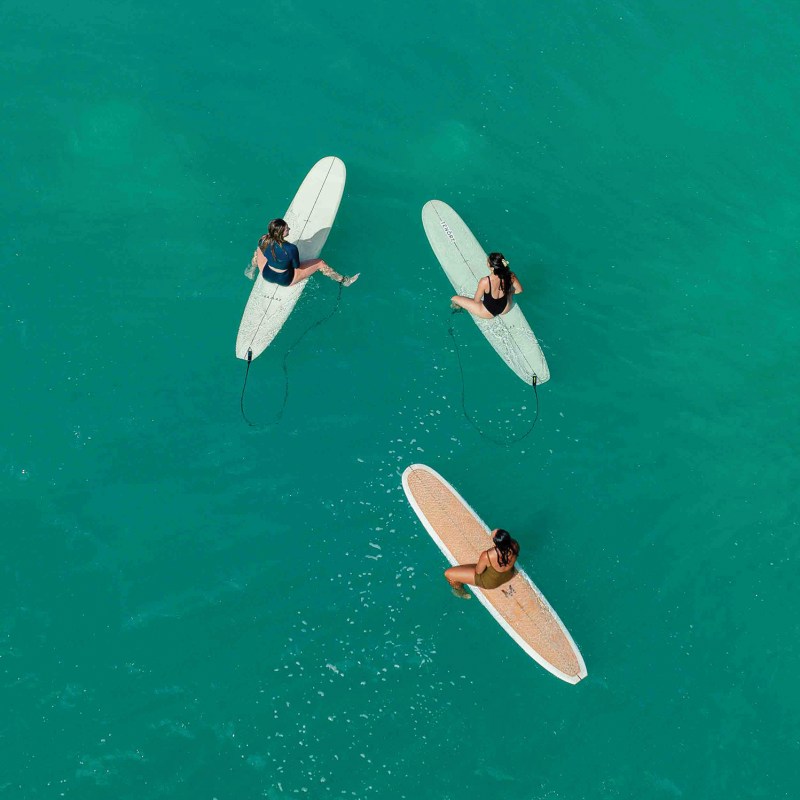
The next morning, Sallas put me on a 10-foot Waikiki, a classic noserider he felt would be much better for a tall gal than what I’d been using, eventually getting me to my goal of cross stepping, cruising, and hanging 10. His various designs crib from knowledge he gained working with the legendary Hawaiian shaper Donald Takayama, and the playful colorways are unmistakable in a lineup.
“A lot of times when people are struggling, they’re just on the wrong board to begin with,” Sallas says. “First we gotta get you on the right board, then you can apply the techniques.”
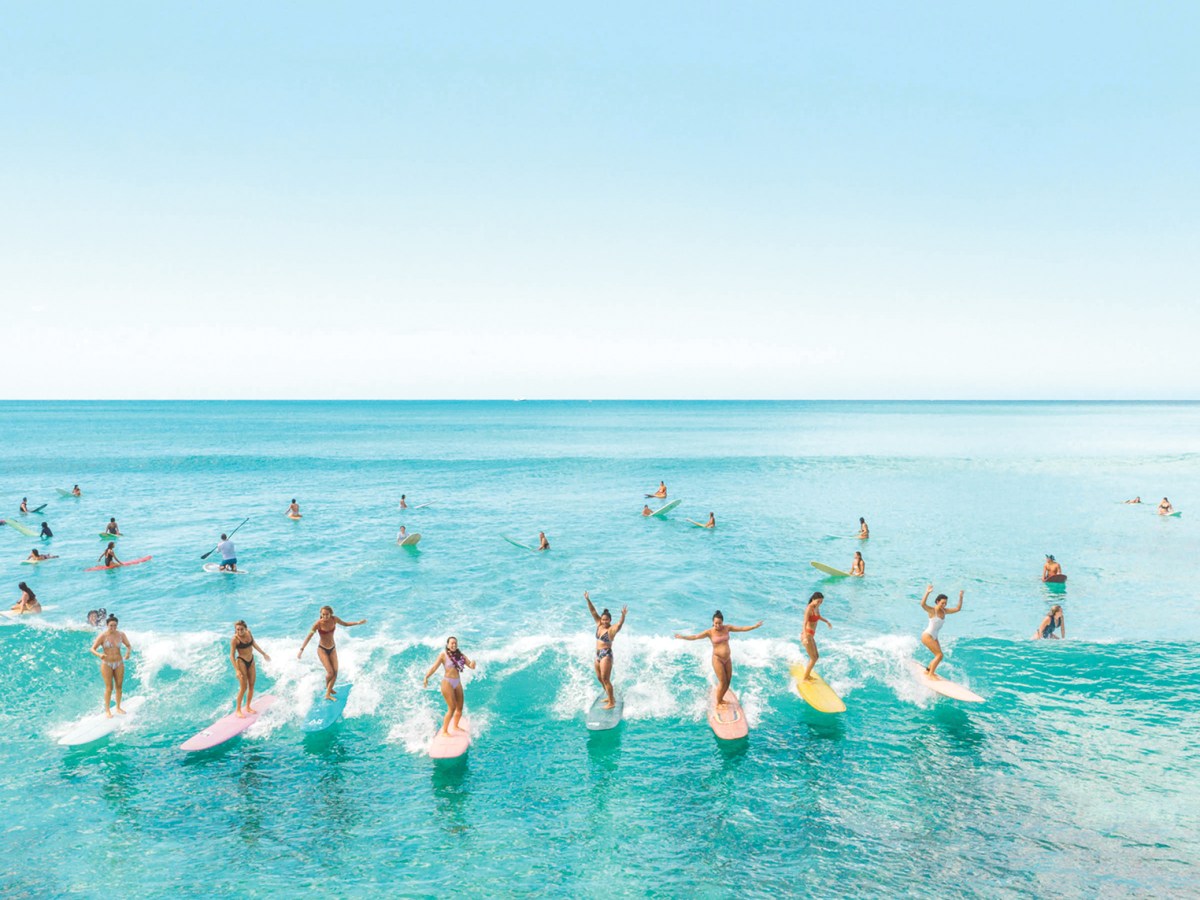
New tools in hand, we headed out for our first session at the break directly in front of Kaimana. It was an intimidatingly big day, which was especially challenging with all of us finding our footing. But frustrations were quelled by cheering each other on and chatting in solidarity between sets. Afterward, we returned to the hotel to review drone footage filmed by local cinematographer Matty Leong, who’d be shooting our sessions all week. As we noshed on tuna tataki and papaya bowls, Sallas went through each one of our waves in detail.
“You can only imagine what you look like so much. You actually need to see yourself surfing, where your feet are, how you’re turning, and where you’re catching the wave,” he says. Watching it all pulled up on screen in front of the group was humbling—and wildly helpful.
It became clear early on that this experience was much more elevated than some of the surf shack getaways I’d seen on Instagram. And the footage review really helped us dial in our goals for the next day.
“One of my biggest things is surfing with intention. Pick one thing that you’re going to work on each session, rather than going out there with an empty mind,” Sallas says. “You’ve gotta go out there with a goal.”
Courtesy of the Kaimana Beach Hotel
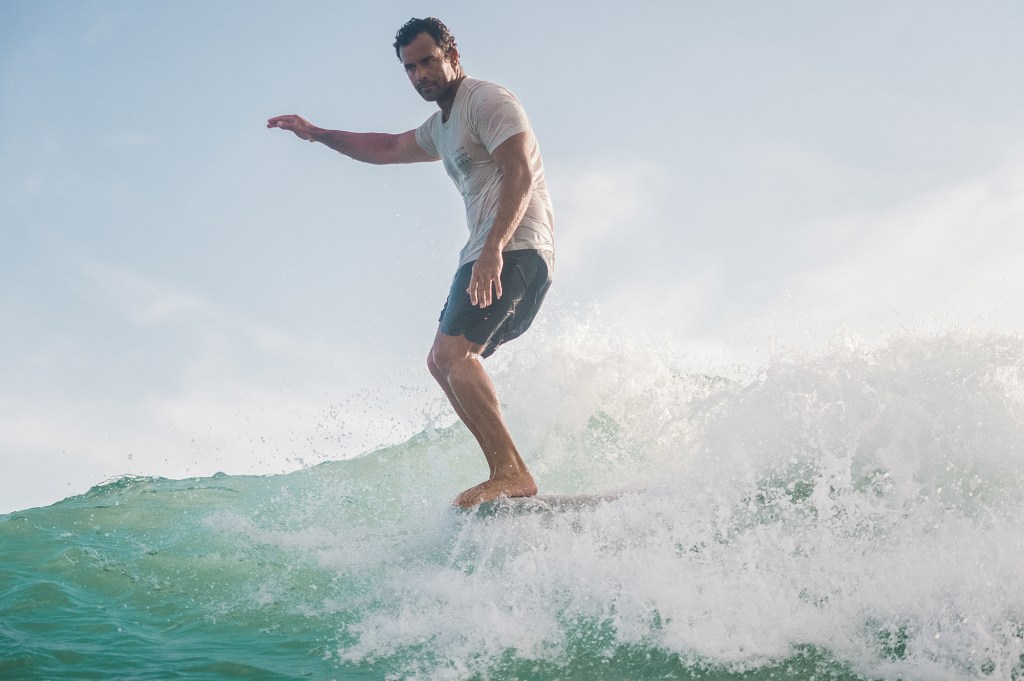
Our days were punctuated by Sallas’ timeless knowledge paired with warm waves, arching rainbows, daily turtle sightings, and the spirit of aloha. His father was a Waikiki beach boy who spread the love of surfing to curious travelers, and he’s carrying that legacy of lifelong learning at these newly launched Oahu overnighters. An added bonus was that each of the five days, he was right out there with us, mitigating locals who otherwise would have been difficult to navigate at popular spots like Queens. Sallas says he grew up on that wave, and every so often, he’d pull into one as a reminder. Seeing his signature style—seemingly effortless noseriding, and elegant long lines at water level—was almost worth the price of admission itself. The fact that he’s still competing is truly an inspiration as a lifelong learner.
“I’m 44 now, and I won my first World Surf League World Championship when I was 42,” he says. “In my late 30s, I really felt myself slowing down. I countered that by saying, ‘Screw this, I don’t want to go down that route.’ I picked up ocean paddling, added in gym workouts, yoga, stretching, and balance exercises, and I won two world titles in my 40s.”
I quickly learned that though Sallas makes cross-stepping and noseriding look graceful and easy, the wish of learning to walk the board by the end of the retreat was a little (okay, incredibly) unrealistic, even as a lifelong athlete. Learning at 40 has been all about continuously swallowing my ego, along with a whole lot of seawater. Even Sallas admits it’s a tough sport to take on, no matter the age; surfing doesn’t have any formal rules or way to replicate conditions like most others do. It’s a whole lot of pattern recognition plus patience, and progress is never linear.
There was a breaking point for every single one of us at the five-day retreat, where that growth process was frustrating to the point of tears. One surfer dropped in on a group of locals at Queens and got cursed out and nearly taken to shore for a throwdown. On a particularly big day, another member of the group just couldn’t seem to land a clean pop-up and catch a ride, and kept trying until it resulted in a breakdown. As for me, I was repeatedly flying backward off my board while trying to cross-step, all with an embarrassingly toasty sunburn I got from staying out too long on the very first day. But we all kept encouraging each other with hugs, yews, shakas, and good vibes. So when the little victories like my first successful baby steps came, they were so, so much sweeter.
Sallas has lived that reality, too. “I’ve placed second in the world four times and third a few times. I’ve missed out by maybe a 10th or a 100th of a point. When you have those moments, you gotta just not give up.”
Courtesy of the Kaimana Beach Hotel
By week’s end, my wave count was high and my “get-back-up muscle” felt stronger. I upgraded from my soft-top surfboard and bought my very own Waikiki to bring back to the mainland. (I lovingly named her Kiki.) But most importantly, I found a new tribe of ocean people. I now consistently surf with one of the women I met down in Santa Cruz, and we have a group chat going with the others to continually encourage each other’s progress.
That, to me, is the heart of wellness: consistent movement, nourishment, time in nature, and a community that buoys you. The ocean asked us to show up, be present, and put one foot in front of the other. Sallas gave us the tools, the intention, and the space. The rest is ours to practice.