How a Precocious Mountain Lion Inspired the World’s Largest Wildlife Crossing
The story of how one woman and one cougar inspired an experiment in reviving the wild within our cities.
© Steve Winter/National Geographic
Beth Pratt and I meet for the first time at an Agoura Hills trailhead early on a Sunday morning. The one concealed by the monumental infrastructure project she’s spearheading. Which, as she gets out of her sensible all-wheel-drive SUV, stuffed with boxes of books, pamphlets, and life-size mountain lion cutouts, feels somewhat off-brand.
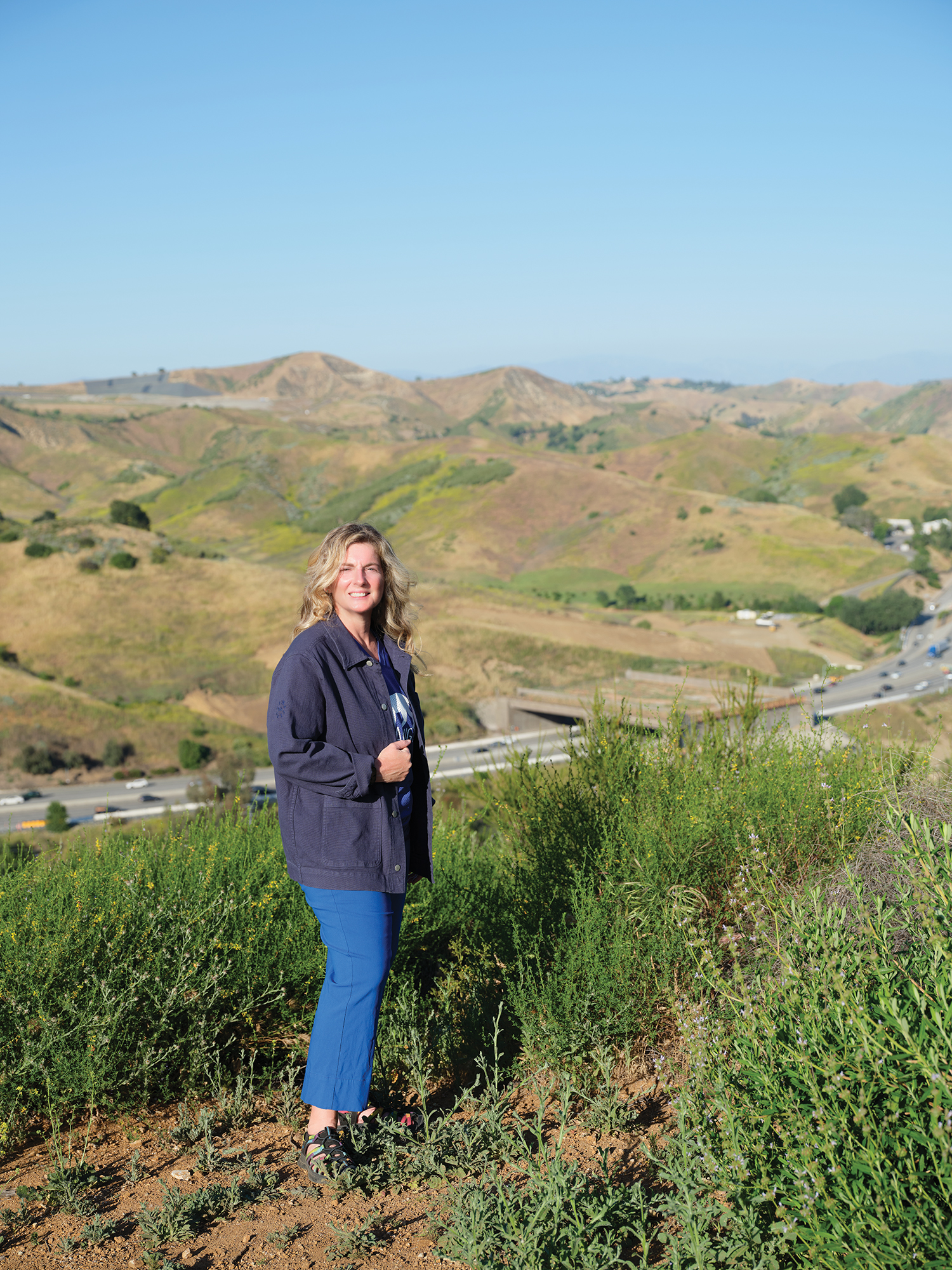
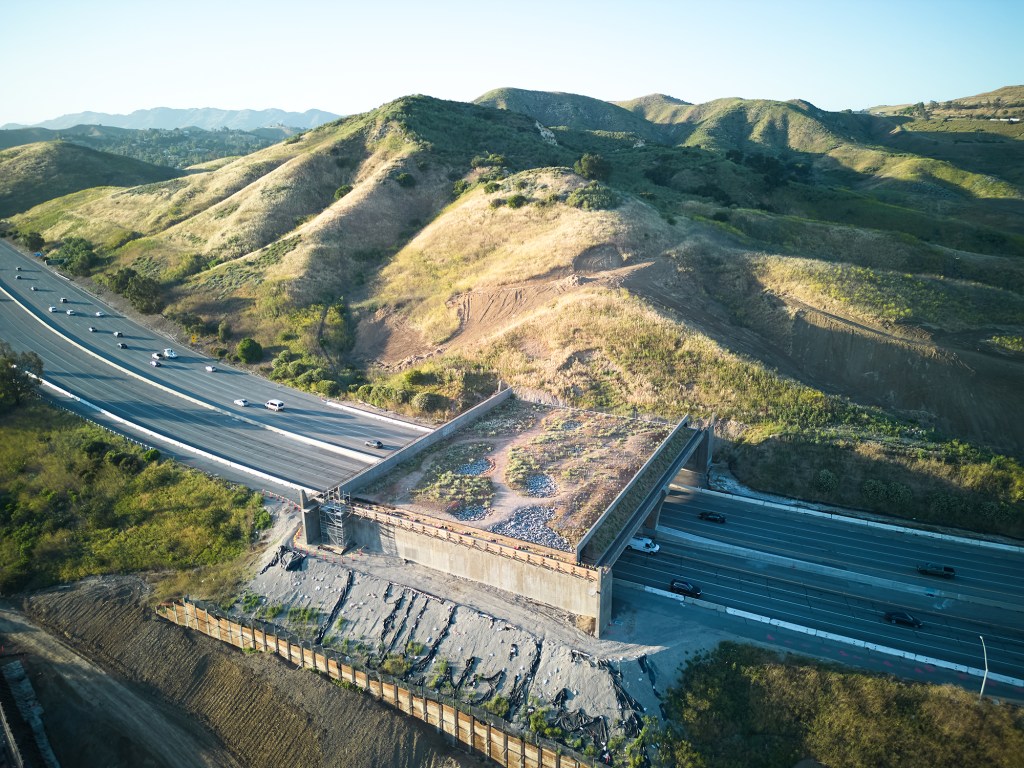
She lives near Yosemite National Park, is a staffer at the nonprofit National Wildlife Federation, and studies butterflies in her spare time. She’s published two books on Yosemite wildlife. She looks every bit the crunchy professional environmentalist, not exactly the type invited to hobnob with Leonardo DiCaprio and Southern California’s most powerful philanthropists. She leads me up a short, steep hike to an overlook in the Santa Monica Mountains. High enough for a proper view of what has become her life’s work: a nearly one-acre overpass unlike any other that spans the 101 Freeway. When it opens, currently set for late 2026, the Wallis Annenberg Wildlife Crossing will be the largest wildlife crossing in the world.
It’s a supersized overpass. Power, water, gas and communication lines had to be rejiggered and buried. That kind of thing is expensive and time-consuming, and not everyone is sold. What started as a back-of-the-napkin idea has grown into a roughly $114 million project, with rising costs fueling criticism. The timing and terrain have placed this earthy moonshot in the public eye at a pivotal moment in the city’s evolution. It is the West’s wide open spaces, laced with mountains and canyons, wildflowers and wildlife, that inspired so many to move here generations ago. Over the years, historic trails became roads that spread into highways and then freeways that truncated migration routes, shrank gene pools, and allowed resilient native landscapes to give way to more combustible ones. Whatever your opinion, this will end up the most visible use case for how cities and suburbs across the West might begin to restore the very landscapes that made them worth living in to begin with, much like how The High Line in New York led to the botanical revitalization of neglected corners of cities around the world. But before looking ahead to what could become, it’s worth understanding how this experiment came to be.
Thomas J. Story
“This is the only place in this entire region where there is protected space on both sides of the freeway,” Pratt says. “It’s the funnel in the hourglass.”
Peering down from above, it’s easy to see. On the north side of the 101, foothills connect to bigger mountains, home to the Los Padres National Forest, which runs north all the way through Big Sur. That’s over 1,000 square miles of wild space. Surrounding our promontory are more than 250 square miles of protected land, in the form of multiple state parks and the Santa Monica Mountains National Recreation Area. Not bad, considering it’s tucked between the upmarket suburbs and Malibu. These two distinct wild spaces share the same ecosystem, the complex and vibrant nature that helped give early Los Angeles its utopian reputation. It’s home to hundreds of native plants and animals, including the charismatic apex predator that drew Pratt down here from her gorgeous Yosemite perch years ago: the mountain lion.
The shallow depression that connects them—Liberty Canyon—has been severed by a roaring freeway. Meaning the flow of life has been cut off. Such a thing is disastrous for threatened species like the mountain lion and its habitat, which is why scientists have labeled this crucial quarter-mile a biodiversity hotspot. And it’s why, for the past 14 years, Pratt has been devoted to repairing this broken ecological link.
“We didn’t know how important connected landscapes were to preserving ecosystems before,” Pratt says with a shrug. “Now we do.”
And yet were it not for one particularly precocious mountain lion, none of this would have happened. Pratt wouldn’t be here with me, and it is doubtful anybody else would have endured a decade and a half of 60- to 80-hour workweeks to help fix it.
You’ve probably heard P-22’s story before. Name another mountain lion that has been featured in newspaper spreads all over the world or profiled on 60 Minutes. But back in 2010, he was just another blind cub born around the Agoura Hills sagebrush, on the wrong side of the freeway.
His father, P-1, the so-called “King of the Mountains,” was the most feared mountain lion among his kind, and he had the largest territory in the Santa Monicas, but there is no nepotism among cougars. Once a juvenile is orphaned by its mother, which can happen as early as 15 months, it is on its own. Adult mountain lions kill young males that stray into their range, but P-22 was locked into the small half of the lopsided hourglass. Without a funnel, there was no safe place for P-22 to go. Crossing the 101 was suicide, so he headed for the city.
He wasn’t discovered there until 2012, when Miguel Ordeñana was a field biologist on an urban wildlife study in Griffith Park—home to the Los Angeles Zoo, the Griffith Observatory, and the Greek Theatre. Not that anybody expected much from the survey. Ordeñana placed camera traps along park boundaries and on an overpass above a stretch of the 101 known as the Hollywood Freeway, which provided a gateway into Hollywood Hills. He collected the SD cards and reviewed the footage before anyone else, meaning he was the first to see the photo of an unmistakable feline posterior.
The photo surprised even the local wildlife biologists who study mountain lions in Los Angeles County. They promptly tracked, collared, and tagged him as P-22. “P” for puma; “22” because he was the 22nd mountain lion collared in the county. Genetic testing determined P-22 was born on the northern edge of the county, which meant he had to cross two of the busiest freeways in the country—the 405 and the 101—to reach the park. A first.
Beth Pratt could hardly believe what she read in the Los Angeles Times. She’d been in love with big cats since she was a kid, thanks to classics like Wild Animal Kingdom and Born Free, the true story about a lioness raised by conservationists, and she had just started work at the National Wildlife Federation. She promptly called Jeff Sikich, a wildlife biologist with the National Park Service, who invited her down to Griffith Park to track P-22. “My first reaction was, ‘Oh my god, get this cat out of here. There’s merry-go-rounds and celebrities walking their dogs. It shouldn’t be here.’” Pratt says.
Even collared, P-22 proved impossible to locate that day, but the more Sikich talked about mountain lions and their challenges in such an urbanized environment, the more it sank in that these cats belong here. This was their domain long before the merry-go-rounds and the celebrities walking their dogs, and Pratt was overcome with an urge to help. Over Thai food that evening, Sikich mentioned how useful it would be to build a wildlife corridor out where P-22 was born. Not that he expected much to come from it.
The next time Pratt and I talk, we are retracing P-22’s steps through the Hollywood Hills, something she’s been doing annually for a decade. Although the exact route the cat carved is unknown, she took a dreamer’s liberties and started her 50-mile hike at the wildlife crossing the day the first seedlings were planted on the overpass. We meet at midday on day three of her four-day trek in Coldwater Canyon Park, where we pick up a trail that winds past wrought-iron and chain-link fences that separate the wild and tangled oak-chaparral vegetation from tame and immaculate rose gardens, swimming pools, and tennis courts. Our destination is the Hollywood Bowl Overlook, six miles away. Below us, Studio City hums.
“This walk really tells the story of what these animals have to navigate,” Pratt says when I ask her why she makes the annual trek. “Navigating these neighborhoods, there’s dogs barking, headlights, noise. He had to navigate these stressful urban settings.”
After Pratt’s initial meeting with Sikich in 2012, she spent a year researching wildlife crossings, a concept that took hold in France as early as the 1950s. At Banff in Canada from the 1970s to the mid-1990s, a series of 24 overpasses and underpasses were built to enable coyotes and bears, cougars and deer, elk and moose to cross the high-speed Trans-Canada Highway unharmed. In 2014, Pratt helped Caltrans apply for a federal grant that would cover a feasibility study to see if a similar wildlife crossing at Liberty Canyon was possible, and she organized a rally that marked the launch of her Save L.A. Cougars campaign.
“I thought 20 people would show up,” Pratt says. 400 people came, including a busload of students carrying signs demanding a wildlife corridor. “It was like, wow, we’re really onto something here.”
P-22 was out living his best L.A. life. When he wasn’t hunting neighborhood deer or feasting on the Canada geese that grazed the fairways on the public golf course, he was sleeping tucked away in the lush Forest Lawn cemetery.
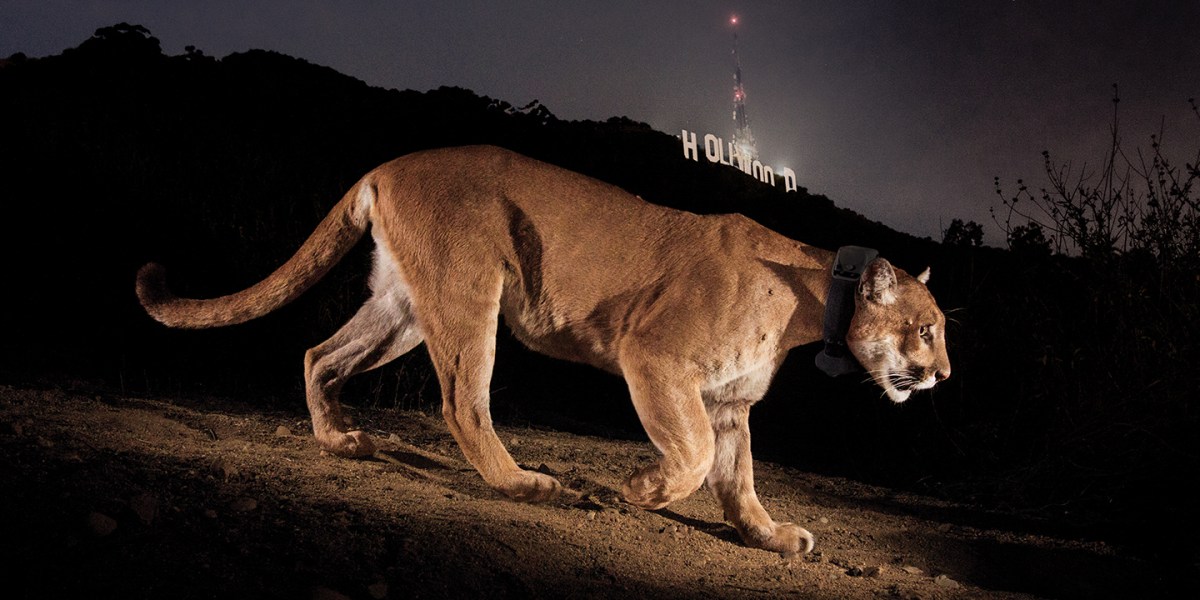
Although his collar did ping in Universal Studios, and the cat certainly cruised Mulholland Drive. In 2013, National Geographic photographer Steve Winter captured a stunning remote portrait of P-22 strolling past the Hollywood sign. People all over the world saw that photograph and fell in love.
“And love,” says Pratt, “is the first step toward action.”
Of course, it takes more than love to build the world’s largest wildlife crossing. It takes cash, and lots of it. The feasibility study proved that Liberty Canyon was the ideal location for a crossing, but an underpass—the less expensive option—wouldn’t work. It had to be an overpass, with an original estimated cost of $56.8 million, and Pratt had never held a fundraising position. “I had no Rolodex,” she says. She started out by courting individuals, soliciting small donations. “I remember when we got our first $500 donation. I was so excited I went up onstage at a rally with one of those big checks.”
She wrangled about $1.2 million from the California State Coastal Conservancy to cover the engineering costs. Then in 2015, Pratt connected with Leonardo DiCaprio and his foundation. He kicked in a big check, and his involvement opened doors. In 2016, the legendary philanthropist Wallis Annenberg met with Pratt and was intrigued by her intelligence and spirit. She ponied up $1 million and watched Pratt leverage it into 20 more.
Pratt came back to the Annenberg Foundation in 2021, once the design was finalized. By then, the construction budget had ballooned to over $80 million, which included burying Southern California Edison’s utility poles, mitigating future fire risk. Annenberg greenlit a $25 million challenge grant, which meant Pratt had to match it to earn the funds. Rising costs, some driven by tariffs, drove the project to its sizable price tag. Over the years, Pratt has continued to work her high-low game. She and DiCaprio remain in touch, and she moderates P-22’s Facebook and Instagram pages. For the nonprofit campaign, she also hocks P-22 swag with the help of her volunteer mom. You could find fault in that brand of fetishization. In fact, Pratt has been criticized for turning P-22 into a celebrity. Only P-22 never was a celebrity. He was a pioneer. Like a wolf venturing into new territories, expanding and strengthening the wild wolf population. “It’s not that individuals are everything in nature,” Pratt says, “but scientists are starting to see that individuals do drive change and adaptation, for the good of the whole population.”
Thomas J. Story
As the sun casts its dusky glow over Mulholland Drive, Pratt and I close in on the Hollywood Bowl Overlook. We reach the easternmost end of Mulholland Drive. Below us, the Hollywood Freeway snakes through the canyon like a writhing anaconda. Pratt and I take a moment to imagine what P-22 must have thought of it. On the other side, we can see undeveloped hills: the promise, or at least the possibility, of safe haven.
Pratt did get to meet him in the end. The very end. She’d tracked him several times and had come close, but it wasn’t until 2022, after he’d been hit by a car and was subsequently diagnosed with Stage 2 kidney disease, and after the euthanasia decision had been made, that she got her face-to-face.
“They let me spend 30 minutes with him. He had this whole room, but he came and lay down next to me. I could feel him breathe. It was probably the first time in history that a wild mountain lion had a blonde woman sob uncontrollably in front of him.”
Pratt spoke to him through a barred gate. He perked his head up and hissed, then he relaxed as she promised him she would see the project through. More than 6,000 donors have contributed to the crossing so far. A retired couple from the Midwest, who had only ever visited L.A. twice, donated $1 million. And $20 donations have tumbled in from Florida and Australia, too.
Without the crossing, some biologists believe that mountain lions will eventually die off in the Santa Monica Mountains, and without an apex predator around, mule deer would multiply, impacting vegetation. That’s how healthy and diverse chaparral habitat devolves into invasive fields of mustard grass, which has proven to be a tinderbox for destructive wildfires in drought-prone Southern California.
The overpass is built, but there is more to the crossing than brick and mortar. There are more than 50,000 seedlings to plant on the one-acre bridge and in the surrounding hills—produced from more than one million seeds collected by hand in and around Liberty Canyon. Once the utility lines are buried, berms will be built to connect the bridge with the mountains on either end. The native plant restoration and the buried power lines will further mitigate future fire risk in an area that has been blitzed by wildfires twice in eight years. Soon, freeway traffic won’t even see an overpass. It will feel like they are tunneling through a wild mountain. When the ribbon is cut later this year, the crossing will be open for native wildlife. “This is going to help wildlife for 100 years,” says Pratt, “and when I was a little girl, that’s all I wanted to do.”
Journalist Adam Skolnick is the co-writer of David Goggins’s bestselling memoirs. His debut novel American Tiger is inspired by a true story about an escaped tiger that roamed the Southern California suburbs.